





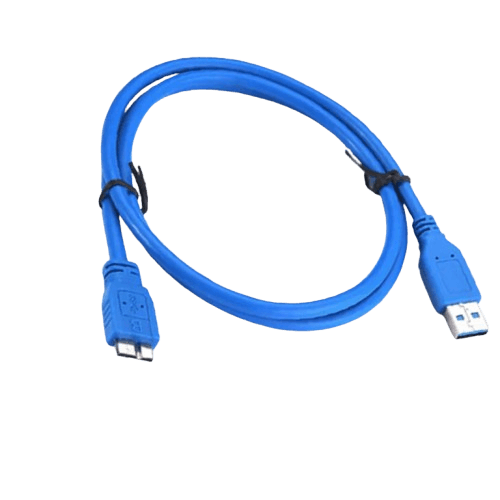
USB to MICRO B (3.0) Cable
- Brand –
- Model –
- Warranty –
රු1,200.00

Free Courier for Warranty Claims
We cover return courier charges within the 1st year! (Click for details)
USB 3.0 Type‑A to USB 3.0 Micro‑B Cable – Specification
🔌 Connector Types
-
Connector A: USB 3.0 Type‑A Male
(Standard rectangular plug used on computers/hubs.) -
Connector B: USB 3.0 Micro‑B Male
(Wider micro‑B plug with extra contacts for SuperSpeed signals.)
⚠️ Note: The USB 3.0 Micro‑B plug is larger than a USB 2.0 Micro‑B plug because it includes 5 additional SuperSpeed pins. Thus a USB 3.0 Micro‑B cable won’t fit in a USB 2.0 micro‑B port at the USB 3.0 plug end.
⚡ Performance
-
USB Standard: USB 3.0 SuperSpeed
-
Max Data Rate: Up to ~4.8–5 Gbps (≈10× faster than USB 2.0)
-
Backward Compatibility:
-
Works with USB 2.0/1.1 hosts, but performance drops to USB 2.0 speeds (480 Mbps) when used with such hosts.
-
🔌 Electrical & Physical
-
Power Delivery:
-
Standard USB 3.0 provides up to 900 mA @ 5 V (higher than USB 2.0’s 500 mA).
-
Conductors:
-
Multiple twisted pairs (including dedicated SuperSpeed pairs)
-
-
Shielding:
-
Foil + braid shielding to reduce EMI/RFI interference.
-
-
Connector Contacts:
-
Often gold‑plated for better conductivity and corrosion resistance.
-
🧰 Typical Cable Features
-
Cable Jacket: PVC or braided for flexibility and durability.
-
Strain Relief: Molded ends to reduce stress at connectors.
-
Colors: Frequently blue accents (USB 3.x standard), black jacket.
-
Lengths: Common lengths from ~0.3 m (1 ft) up to 3 m (10 ft) or more.
-
Standards: RoHS / REACH compliant often.
📊 Pinout (High Level)
USB 3.0 cables carry both USB 2.0 signals and additional SuperSpeed pairs:
-
USB 2.0 Signals:
-
VBUS (5 V), D+, D–, GND
-
-
SuperSpeed Signals:
-
Two differential pairs for SuperSpeed transmit/receive + additional ground reference.
-
📌 Where It’s Used
-
External HDD/SSD enclosure connection to a PC or laptop.
-
Cameras, camcorders, and some smartphones with USB 3.0 Micro‑B port.
-
Data and charging cable for compatible devices.
| Weight | .2 kg |
|---|
Based on 0 reviews
Be the first to review “USB to MICRO B (3.0) Cable”
Related products
-
-
-
CCTV ACCESSORIES, CONVERTERS, POWER /VGA / HDMI/USB CABLE, PROJECTOR MOUNTS & ACCESSORIES
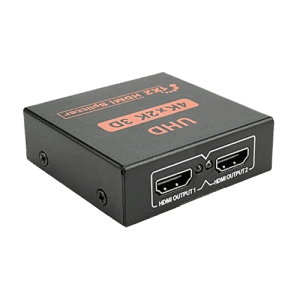
HDMI 2-Way Splitter 1×2 (1 Input to 2 Outputs)
 CCTV ACCESSORIES, CONVERTERS, POWER /VGA / HDMI/USB CABLE, PROJECTOR MOUNTS & ACCESSORIES
HDMI 2-Way Splitter 1×2 (1 Input to 2 Outputs)
- Product Type: HDMI 2-Way Splitter (1×2)
- Input: 1 HDMI Source (PC, Laptop, PS4/PS5, TV Box)
- Outputs: 2 HDMI Displays (TVs, Monitors, Projectors)
- Resolution Support: Full HD & 4K Ultra HD Display
- Warranty: Store Warranty
SKU: n/a -


There are no reviews yet.