







CONNECTORS , ADDONS & TOOLS, NETWORK CARD AND ADAPTER, NETWORK SOLUTIONS
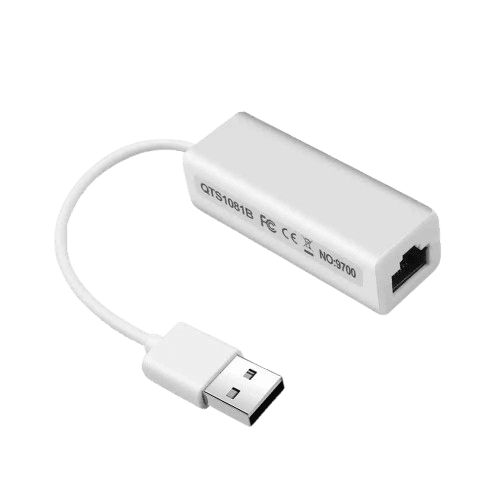
USB Ethernet Adapter
Availability:
Out of stock
- Warranty –
- Brand –
- Model –
රු1,300.00 or 3 X රු433.33 with


Out of stock
Key Specifications & Standards
| Parameter | Typical Value / Standard | Notes / Implications |
|---|---|---|
| USB Interface | USB 2.0 (High Speed) at up to 480 Mbps | USB 2.0 “High Speed” is what’s used; it is backward‑compatible with USB 1.1 (Full/Low Speed). Real throughput is lower than the line rate because of protocol overhead, latency, etc. |
| Ethernet Speeds Supported | Common: 10/100 Mbps (Fast Ethernet) — 10Base‑T, 100Base‑TX Some: Gigabit (1000 Mbps) Ethernet over USB 2.0 adapters exist, but their throughput is limited by the USB 2.0 bus (see below). |
|
| Duplex Modes | Half‑duplex and Full‑duplex supported for 10/100 Mbps; for 1000 Mbps if the chip supports it (and cable, switch, etc.) | |
| Auto‑Negotiation / Auto‑MDIX | Usually supported – the adapter and the network device will negotiate speed/duplex and the correct wiring/crossed cables (MDIX) automatically. | |
| Power | Bus‑powered from the USB port (no external power supply needed) in most cases. | |
| Standards Compliance | Follows IEEE 802.3 for 10Base‑T, IEEE 802.3u for 100Base‑TX, sometimes IEEE 802.3ab for Gigabit, etc. | |
| Cable & Physical Interface | RJ‑45 port for Ethernet; Category 5 / 5e / 6 cables used depending on needed speed. USB “Type A” male (or other form) to connect to host. Connector plating, jacket type, etc vary. | |
| Operating Conditions | Varies: typical operating temperature from ~0 °C to 70 °C, sometimes more narrow. Storage temp: lower/higher extremes. Humidity, etc. | |
| Indicators / LEDs | Many have Link and Activity LEDs; sometimes also speed indicators. | |
| OS Compatibility / Drivers | Windows, macOS, Linux usually supported; some adapters use chipsets which are well‑supported and drivers are built into kernels. Others require driver installation. | |
| Additional Features | Some support Wake‑on‑LAN; Jumbo frames (on Gigabit versions); suspend/resume; traffic offloading (checksum offload etc.) on more capable chips. |
| Weight | .5 kg |
|---|

There are no reviews yet.